
Driggs Criminal History Checks
A Driggs address is not enough to pick a record office. The author and stage of the event control access. City administrative files stay with City Hall, a deputy's narrative stays with TCSO, an ISP report stays with ISP, and filed charges and dispositions belong to the Teton clerk. Use a narrow sequence instead of sending a broad name request to every office.
- Read the citation, report heading, or incident number to identify the agency that created the Driggs source report.
- Request that report from the author, using the county public-information channel when TCSO responded.
- Search Teton County in Idaho iCourt, with the exact case number or a party name in LAST, FIRST order.
- Ask the clerk at 150 Courthouse Drive for a public case document, kiosk access, or a certified disposition.
- For present custody, confirm placement through TCSO and contact Madison County Jail; use BCI for one's own statewide Idaho history.
Driggs Is Teton's Records Hub
Driggs concentrates the county clerk, Court Assistance, prosecutor, and sheriff access in or near the county seat. The Teton County Courthouse at 150 Courthouse Drive is the operational court-record center. The clerk publishes 208-354-8771 and clerk@co.teton.id.us. Court Assistance uses 208-589-9872. These contacts make Driggs the physical starting point for county case documents even when an event happened in Victor or Tetonia.
That concentration does not merge the records. The courthouse does not become the holder of the police narrative merely because a prosecutor filed charges. The sheriff does not issue certified judgments. City Hall does not hold a Madison booking file. A Driggs search is faster when the requester names an existing record, the date, the agency, and any case or incident number.
Records at the Driggs Police Department
No verified dedicated Driggs police-record form or city criminal portal was found on the official sources reviewed. The City of Driggs website and its published main number, 208-354-2362, are appropriate for confirming current city departments and administrative-record contacts. They should not be treated as an unverified arrest-search service.
For a public-safety event, identify the responder. A Teton deputy report goes through the sheriff's public-information process; an Idaho State Police traffic or investigation report goes to ISP. If a city officer under a current local arrangement created the report, confirm the proper city channel before filing. The absence of a universal Driggs form is a reason to verify authorship, not a reason to invent a records unit, fee, or turnaround time.
Driggs City Hall, Sheriff, or Clerk?
Three offices in Driggs can answer three different questions. City Hall can locate city administrative material. TCSO can address a deputy-created incident or arrest report. The clerk can provide the public judicial file after a case is opened. Matching the question to the office prevents a docket summary from being mistaken for the event narrative.
| Question | Driggs starting point | What it cannot replace |
|---|---|---|
| What city administrative record exists? | Driggs City Hall | Sheriff report or court file |
| What did the deputy document? | Teton County Sheriff's Office | Filed charge or final judgment |
| What happened in court? | Teton County clerk and iCourt | Police narrative or Madison intake |
| Is the person currently held? | TCSO placement line and Madison jail | Proof of conviction |
The same Driggs name can appear in more than one layer. Compare identifiers rather than assuming every same-name row belongs to the same person.
Booking and Arrest Records in Driggs
Driggs operates no jail, and Teton County has no detention facility. As of January 1, 2026, TCSO says all Teton inmates are housed at Madison County Jail, 145 E. Main Street in Rexburg. Madison's detention number is 208-372-5002. TCSO handles bond and placement questions at 208-776-8223 and retains the local arrest, transport, or source-report side of the event.
Madison creates the booking number, intake time, fingerprints, photograph, custody status, release data, visit records, and jail-call records. Confirm placement before travel or deposits. The 2024 Jefferson County contract is historical and should not be used as the present default. A current Driggs booking can therefore involve a report in Teton County, a detention record in Madison County, and a court case back in Driggs.
Driggs Has Two Courthouse Stories
The older 1924 courthouse is a National Register-listed local landmark. Modern justice operations, however, use the Courthouse Drive complex. Historic photographs, archived directories, and older narratives can lead a Driggs researcher to the wrong building if the distinction is missed.
For present case access, use 150 Courthouse Drive and confirm counter hours or holiday closures before leaving. The county's ordinary business-hours convention is 9 a.m. to 5 p.m., but the research does not establish a separate guaranteed court-counter schedule. The courthouse kiosk is useful when a public document is not visible through iCourt's web view. Photography or recording rules in a courtroom are separate from the right to request a record.
This distinction also affects older Driggs research. An address printed on an old docket, newspaper clipping, or historic photograph may describe the courthouse of its time rather than today's records counter. Keep the date of the source beside the address, and ask the current clerk how an older public file is stored. Do not assume an older case is absent merely because the modern web portal has no row. The clerk can explain whether a public index, archive, or copy request is the appropriate path without turning the historic building itself into a present-day records destination.
The Driggs Municipal Court File
There is no standalone Driggs municipal-court database. Idaho's integrated Magistrate Division handles infractions, misdemeanors, initial appearances, and felony preliminary hearings. District Court handles felony cases after bind-over or indictment. Both are part of the Seventh Judicial District structure, with Teton filings managed through the county clerk.
| Court Name | Teton County Magistrate Division and District Court |
|---|---|
| Case Types Heard | Traffic and other infractions, misdemeanors, early felony proceedings, and felony cases at the proper stage |
| Case Lookup Channel | Idaho iCourt Portal, courthouse kiosk, and Teton County clerk |
| What the Docket Shows | Parties, charges, bond details, hearings, register of actions, disposition events, and financial information when public |
| Copies & Fees | Request available plain or certified documents from the clerk and confirm current copy and mailing charges |
A city or traffic matter can appear under the county court structure without any separate Driggs portal.
Using iCourt for Driggs Cases
The Idaho iCourt Portal is the statewide basic case-information index. Search an exact record number or enter the name as LAST, FIRST. Wildcards require at least four letters before the asterisk. Select Teton County, and clear advanced filters after each search because a persistent filter can silently hide later Driggs results.
| iCourt field | Driggs search practice |
|---|---|
| Record number | Copy the full format from the citation or court notice |
| Party name | Enter LAST, FIRST and verify details carefully |
| County | Select Teton for a locally filed Driggs case |
| Hearing search | Choose hearing type, search type, criteria, and date range |
Sealed cases may return no results. Basic iCourt information is not a certified judgment, police report, or complete criminal history. Ask the clerk for the needed document.
How Driggs Records Reach the County
A Driggs event begins with the responding agency's report. If a detention occurs, Madison creates a separate intake file. The prosecutor selects the filed charges, the clerk opens the judicial case, and the court records pleas, motions, hearings, disposition, and sentence. Fingerprint-supported events and reported dispositions may also enter Idaho BCI.
Record flow: Driggs responding agency › Teton County Courts › Idaho State Police BCI
Each layer answers a different question. The report describes what the officer documented. The booking file describes custody. The court file shows the adjudicated path. BCI compiles qualifying statewide repository events. A missing Driggs item in one system does not erase a source record held by another.
Timing can make those layers disagree for a while. A booking charge can precede the prosecutor's filing choice, and the court disposition can reach BCI after the docket is updated. When reviewing one's own Driggs record, note the date each source was obtained and use the final court document to address a missing outcome. That approach is more reliable than assuming the newest-looking website has the most complete version of every stage.
Requesting a Driggs Incident Report
TCSO's public-information request page is the verified route when a deputy authored a Driggs report. A narrow request should give the incident number, date, location, parties if known, and the exact item, such as a final incident report or booking-related transport sheet.
The county form states a three-working-day response framework, with written notice and up to ten working days when more time is required. Fees can follow state law, county resolution, and judicial order. Complex labor may require advance payment, and the form does not promise one flat sheriff-report fee. Judicial case documents should go to the clerk, while Madison custody material should go to Madison. Asking TCSO for a document it did not create can only redirect or delay the Driggs search.
Reading Driggs Crime Counts
Driggs city figures must come from the exact reporting agency and year, not the Teton County total. Verify twelve months of reporting in the official Crime in Idaho system. A missing month or blank field does not mean zero incidents. Seasonal visitors and a small resident base can also change rates without the raw count changing much.
The official Crime in Idaho interface shows the source readers should use to select the relevant agency and reporting period.
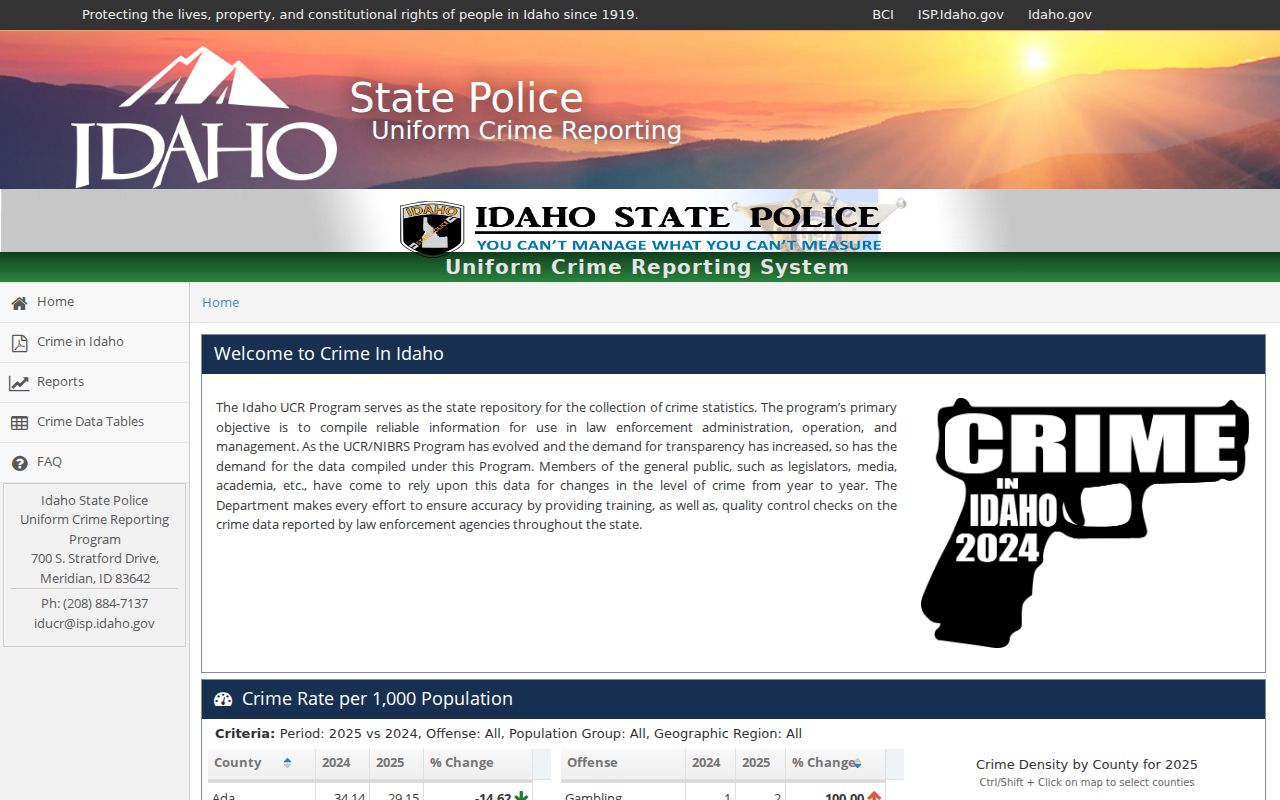
The interface makes agency and time choices visible, which helps prevent a county total from being mislabeled as a Driggs city count.
The county's 2024 TCSO jurisdiction report contains countywide figures and must not be divided among Driggs, Victor, and Tetonia. Statistics are useful for understanding an agency's workload or a period's reported pattern. They are not person-level records and do not establish guilt. For an individual Driggs event, use the source report and court disposition.
Driggs Record Access Rules
Idaho public-record law applies to existing city and law-enforcement records, while court access follows its own judiciary rule. Active investigative content, juvenile and victim information, protected personal data, sealed material, and other exempt matter can be withheld or redacted. A custodian does not have to create a new Driggs report or answer a questionnaire disguised as a records request.
Key Statutes:
Idaho Public Records Act - governs requests for existing public records and recognizes lawful exemptions.
Idaho Court Administrative Rule 32 - controls public judicial-record access and restricted case information.
Idaho Code title 67, chapter 30 - governs BCI criminal-history dissemination and Idaho's limited shielding and expungement remedies.
If access is denied, ask for the legal basis in writing. For one's own record, correct the source court or agency data and provide supporting material to BCI when the statewide history is wrong.